- DIE TRYING
- Posts
- DIE TRYING 022
DIE TRYING 022
Publish, Project or Perish

Michael Barnes
February 12, 2026

One crafty writer’s never-say-die quest to tell a story for the page or screen.
DIE TRYING is a work in progress.
Watch me tickle, in real time, the fat bottom of a garish rooster that never crows.
I’m attempting to sell a screenplay. If that fails, I’ll publish it as a novel. If that fails, I’ll document why.
And it will soar. No grim failure porn here.
This isn’t motivation, “branding” advice or Hollywood mythmaking. It’s a candid record of submissions, silence, false momentum, real momentum and the head toll of trying to make something exist in a market designed to ignore you.
If you write, read scripts professionally or are trying to understand how stories actually move through the system, this is for you.
If not, it probably isn’t.
 | GOOD & EVIL IN THE GARDEN OF SINNERS |  |
I believed in good and evil, like most American boys, building forts out of empty shoeboxes on the stairs of my childhood home, where my good guy G.I. Joe action figures faced off against the dastardly Cobra Commander and his henchman.
The binaries of good and evil are central to the American mythos — white-hatted cowboys facing off against the black hats, the ragtag American Olympic hockey team against the hated, mighty Soviets in 1980’s “Miracle on Ice.”
The binaries in American movies helped give rise to this black-and-white American interpretation of the world. Aw shucks farmboy Luke Skywalker grew to lead the resistance against black-clad Darth Vader and his evil empire.
When you write a script, you have a protagonist and opposite antagonist who impedes the hero’s goals.
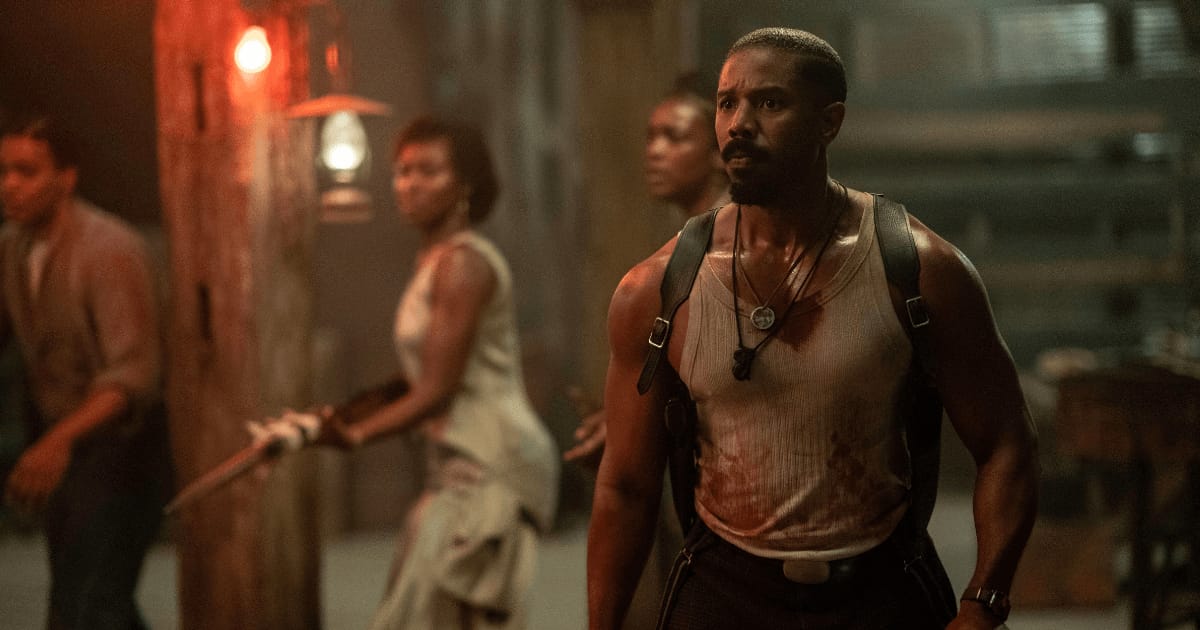
Binaries dominate one of the year’s biggest films, Writer-Director Ryan Coogler’s SINNERS, which has garnered 16 Academy Award nominations, the most in Oscar history.
Let’s analyze the film’s screenplay to see how binaries shape the narrative structure and its thematic backbone that only art, like blues music, can transcend the destructive cycles of good and evil slugging it out over centuries of human struggle.
BITE ME BINARIES
SINNERS opens with a prologue in which Annie, a character later revealed to be a witch-like shaman, narrates over shots of musicians performing on woodcuts from over the ages.
In a voice-over, she declares only “people born with the gift of making music…can pierce the veil between life and death.”
Right from the start, the film’s theme emerges: gifted musicians, like a bluesman and his guitar, can puncture binaries like life and death.
From there, we meet the gifted black musician, Sammie, working as a sharecropper in a Mississippi plantation. He wants to unleash his guitar skills that his preacher father, Jedidiah, considers sinful.
Coogler establishes another binary in the form of father and son. Holy preacher who warns that “music for drunkards and philanderers” will lead his wayward son to the devil, who “gon’ follow you home.”
Sammie soon joins his older cousins Smoke and Stack, two twins who returned south from the mean streets of Chicago to open a juke joint in an abandoned lumber mill.
The twins are an anti-binary. Two men of action, joined at the nucleus by birth, who have the street smarts, money and bullets to challenge the white Klansmen who oversee the town and later fight off the vampires who crash the party and literally separate the “together forever” twins.
The vampires, led by the Irishman music man Remmick, are after Sammie and his gift. They seek eternal connection from their severed souls in the afterlife. Remmick tells Sammie, “I want your stories. I want your songs. And you will have mine.”
The vampire Remmick violently baptizes the baby bluesman in the water, telling him, “We are earth, and beast, and God. We are woman and man. We are connected, you and I, to everything.”
Across the dual worlds of heaven and hell, vampire and man, black and white, music and art are the connection that transcends these opposite realms.
Coogler deploys binaries in the characterization, thematically and stylistically. The script has surreal touches amid the “real-life” propulsive action tropes.
Take the figure of Remmick. In the prologue, the vampire figure is attracted to the musicians on the totemic woodcuts as a “FIGURE with RED EYES” who “peers in the window.”
Red eyes are a pretty mundane and seemingly simplistic visual signifier and foreshadower of the baddie.
Later, the prose gets more surreal and stylized, describing how Remmick dances in the center of the lumber mill dancefloor surrounded by fellow bloodsuckers, seeking to transcend the vampiric sentence: “His tears flow, and his arms swing through the night air unencumbered by the stunting shackles of the colonial gaze.”
Black former slaves and oppressed Irish vampires just want out of the endless cycle of bondage and freedom, heaven and hell, life and death.
And in Sinners, only art and the figure of the cosmic bluesman can pierce this veil.
THIS WEEK IN DIE TRYING
Failed interviews with executives where I couldn’t get my iPhone to record: 1
Time spent rewriting Going Perm: 5 hours
Reads requested: 1
Mood: “Art is the only way to run away without leaving home.”—Amadeo Modigliani
| THE NOBLE & THE SAVAGE | |
If you’re reading this because you write, read, develop or sell scripts:
Are elevated genre plays like SINNERS the only way to approach art in modern-day Hollywood?
Hit reply. I read every response.
—Michael
